A BLOG ABOUT COMMUNICATING COMPETITIVE ADVANTAGE
  • Brian Faulkner
  • Blog
  • CONTACT

If You Want a Great Job, Interview companies With Good VIBES.

11/17/2014

0 Comments

 
PictureImage © by Brian E. Faulkner
Have you ever noticed how some businesses just wrap themselves around you and make you feel welcome, whether you’re a customer or a new graduate looking for a job?

I have found after many years consulting to businesses of all sizes (about communicating their culture and competitive advantage) that you can walk onto a sale floor, into a company headquarters or manufacturing plant and know immediately which organizations “click” and which do not.  The businesses that connect have good vibes.  There’s positive energy.  Their leadership is genuine, sometimes even inspired.  The people are real.  They’re not just plodding along toward quitting time.  They’re into what they’re doing -- and believe in it.  The organization shares a clear purpose and vision that are not just words on some poster hung in the break room.

My son-in-law works for REI, a national retailer of recreational equipment, clothing, footwear and other attractive, well-chosen merchandise targeted to the outdoorsy crowd.  He is enthusiastic about the company, which is organized as a consumer cooperative in which members get a dividend check every year for around 10% of a generous array of eligible merchandise purchased during that year, after paying a one-time $20 membership fee (you don’t have to join to shop there).  The more members buy at REI, the better the deal – it’s built-in.  REI also offers its members occasional deals that seem unusually attractive, in addition to store-wide sales that really are sales and not just come-ons.  

The point here is that REI has both a purpose (to make the outdoor life available to more people at a good price) and values (which seem to be that people matter and the environment matters).  The company uses words like approachable, collaborative, casual and playful to describe the work experience.  Everybody with more than 20 hours a week gets health care.  My son-in-law (who’s in retail management in an Atlanta-area REI store) says that the people who ultimately “stick” with the company buy into the REI experience (not to mention their generous performance incentives and retirement plan).  They may have come in just looking for a job but end up finding a passion for work that knits comfortably into the fabric of their lives and helps assure a secure future for them and their families.

The point here is not to suggest going to work at REI, although this perennial placeholder toward the top of Fortune magazine’s Top 100 Best Companies to Work For would be a great choice.  You may find something just as rewarding in some other retail setting, in a small manufacturing plant or even a big company.  I have seen what, just for this article, might be called the “REI Effect” in all kinds of workplaces where business leadership and employees are in-synch and often unusually productive.  They know what their purpose is, how their customers benefit, where they are going, and “what’s-in-it-for-me”, which could be just as true for a non-profit -- such as a school – as for a commercial enterprise. 

So, if your goal is to find a work experience like the one exemplified by REI, try “getting a job” using a more differentiated strategy.  Check the place out if it’s a retail store.  Watch how the “team” works.  Ask challenging questions about the merchandise and see if they rise to the occasion – even if it’s almost closing time.   Ask people how they like working there.   If you want to work for ABC Corporation or XYZ Manufacturing but can’t get immediate access, vigorously research them online.  Talk to people who already work there; figure out where they go for lunch or to chat after work.  Then request an interview with a company manager you’ve targeted (by name) before you even apply for the job.  If HR gives you the stiff-arm, try calling the person directly and leave a message that inspires them to call you back.  Let them know that you're interviewing them (and others).  Talk to that manager about opportunities at the company, get other inside introductions and take a tour. If you want a sales position, ferret out some of the company’s customers and talk to them.  This approach should pay off, whether you’re just out of school looking for your first position or a work veteran who has been “right-sized” out of a job (maybe especially so if you’re that person because you can more readily perceive what you want to see and don’t want to see).

It’s also instructive to remember that the world does not owe you a job.   But you do owe yourself a good job.   You are no mere commodity, and you’re not seeking commodity-like work.  You have value, knowledge, experience and intelligence to add to the employer’s collective purpose -- and to their customers’ satisfaction.  And you have every right to enjoy your work.

Look for that “REI Effect”, perhaps in one of the other 99 companies on Fortune’s Top 100 list.   And don’t be satisfied with less.  Because you’re worth it.

TakeAway:  A job infused with passion and purpose pays big dividends.  Use a differentiated job search strategy to find one.

Content © by Brian E. Faulkner

0 Comments

The Customer is Culture at this Successful Company.

11/10/2014

0 Comments

 
Picture
Bob Tiffin gets up every morning a happy man.  After early meetings with his management team, the genial founder and CEO of Tiffin Motorhomes takes to his office, phone to ear, eager to speak with his customers. 

He knows he’ll get the calls, first because he invites them.  And second, because motorhomes are complex products and they need service from time to time.  An array of different systems must work as one to keep 30-48 thousand pounds of vehicle, 100-150 gallons of diesel fuel, 90 gallons of fresh water, 100+ gallons of waste water, plus cabinets, furniture and personal belongings (not to mention driver and passengers) rolling down the road. 

“A motorhome, first of all, is a home,” Tiffin points out. “It has everything a home has, but on wheels.  It also has hydraulics and a diesel engine – like a backhoe.”  Not to mention the finest TV and electronics packages available.  Plus a fine kitchen, an air conditioning system and two electrical systems, including a generator.  And it all has to operate properly at sea level or at 11-thousand feet and accommodate a variety of climate and road conditions.  From chassis to engine to handcrafted cabinetry to exceptional fit and finish, the company’s quality standard is high, whether an owner vacation travels or lives full time in their motorhome.  

“Our customer sets the standard,” says Tiffin.  “The customer is the culture of our company.  We think about them when we design our products.  We think of them every minute of every day and do everything we can to help them.  We have 200 employees in our service department.  Fourteen techs each take 30-40 calls a day.  And CoachNet takes the calls after hours and on weekends.” (CoachNet is a leading provider of 24/7 technical and emergency roadside assistance for motorized and towable RVs with a network of more than 40,000 service providers throughout the U.S. and Canada.)

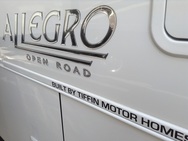
“My three sons work with me in the business, and we meet every day with our engineers to go over each problem we got a call about the day before,” notes Tiffin.  Many of the fixes to those problems find their way into the company’s six Class A motorhome lines, which range from Allegro Breeze, the smallest rear engine diesel coach on the market, to the lavish Zephyr, “45 feet of sumptuous grandeur loaded with more features than we’ve ever put into a motorhome,” including a residential style fridge, two bathrooms and a stacked washer / dryer combo.  

Picture
Image © by Brian E. Faulkner
Picture
http://tiffinmotorhomes.com/
Picture
Image © by Brian E. Faulkner
Bob Tiffin’s customer service passion is rooted in values instilled in him by his father, Alex Tiffin, whom Bob watched do business in the family lumberyard and general store in rural northwest Alabama from the time he was a little boy:
Build it well.  Make it better.  Back it with good service. Treat customers the way they    would want to be treated.  And always answer the phone.
These days, if Bob Tiffin isn’t in his office taking with a customer on the telephone, he’s more than likely talking to a customer in-person, at the Tiffin plant in Red Bay or on the road somewhere.

“If you can’t look your customers in the eye, you can’t do business with them,” Tiffin believes, a maxim that goes back to the Tiffin Supply Company days and has stuck with them since the family acquired and developed a motorhome manufacturing business after one of their customers went bust forty-odd years ago. 

The product may be more sophisticated these days, but Tiffin’s attention to the basics remains the same – in fact, it’s at the nexus of quality and service that Tiffin Motorhomes really shines.  The company is known not only for meticulous attention to design and manufacturing but also for Bob Tiffin and his legendary customer service, all of which combine to set Tiffin apart in a business where the competition isn’t shy about contending for market share.

“There used to be something like 100 motorhome manufacturers,” Tiffin says.  We’ve survived four major economic meltdowns since we started in business, and now there are only 6-7 manufacturers left.”  Which says a lot about his company’s products and the people who build and service them.

Just ask a Tiffin owner.

“Our customers talk about us around the campfire,” he points out. “We want them to say that we try our best to help if there’s a problem.  We don’t sugarcoat the fact that motorhomes can be challenging.   If there’s an issue, we ask our customers to call us, contact one of our 85 dealers, or drive to the factory.  Ninety-nine percent of the time, we’ll fix whatever needs to be fixed.  Because it’s our name that’s on their motorhomes.”   

Bob Tiffin gets it.  He gets it that the promise of quality begins on day one of the manufacturing process, continues through sale and delivery (by a limited number of carefully chosen Tiffin dealers) and extends through the entire ownership experience.  His team gets it too, understands that integrity is the foundation stone on which their current and future business success rests.  The promise Bob makes to Tiffin owners, the promises his sons make, and the promise that every associate in the Tiffin family makes is part of each motorhome that heads up the road from Red Bay.

“Customers invest from $100,000 to more than $500,000 in their motorhomes,” the founder says.  “Sometimes that’s their whole life’s savings.  And keeping them happy is our job” -- a Marketable Truth© deeply embedded in Tiffin’s long-time tagline:

“Where You Go, We Go!”

TakeAway:  Live your integrity.  A reputation for excellence will follow, and your customers will brag on you.

Content © by Brian E. Faulkner      Marketable Truth
© by Brian E. Faulkner   

0 Comments

Godiva's Alluring Words & Enduring Promise.

9/18/2014

0 Comments

 
Picture
Tags: Godiva chocolate, Chocolatier, Trufflelata,  Target

When I traveled for business more than I do now, I’d occasionally come across a Godiva boutique and add a small purchase of their memorable chocolates to my personal expenses. 

It was a pleasant surprise to turn a corner in some upscale mall or market and spot the luxurious Godiva logo.  No matter where my thoughts had been, they immediately shifted to “chocolate” and the stolen moment I was about to experience.

I always picked the simplest dark piece from among the tempting individual choices and array of gold boxes – nothing fancy, just the one I imagined would deliver the purest Godiva experience without complicating it with other flavors.  After enjoying one (maybe two if I wasn’t in a hurry), the rest of my purchase got packed away for the trip home. 

Now flash forward to news that Godiva has launched a temptation called Trufflelata™, a creamy soft-serve shake made right there in the boutique with your favorite truffle blended in: Chocolate Lava Cake, Salted Caramel, Strawberry Crème, Hazlenut Crunch -- even Oreo Trufflelata.   Take your delightful pick.  

The alluring Trufflelata description and photography reminds me how good Godiva is at making us crave their products (with packaging, color, lighting, visual impact, aroma) -- same for their line of GODIVA Liqueurs announced earlier this year, including a Dark Chocolate offering they describe as “a delicious full-flavored indulgence with less guilt.” 

From way back in 1926, when chocolatier Joseph Draps first opened his Brussels shop, Godiva has been superb at crafting words to describe their “extraordinary richness and design, a collection of passion and purity” (the founder's words).  Today’s wordsmiths describe Godiva as “a sought after name with the timeless quality of passion, style, sensuality and modern boldness.”  Their corporate boilerplate proclaims GODIVA Chocolatier as a brand that “consumers universally associate with prestige, elegance and quality …”

I am taken with Godiva’s consistent ability to describe itself in words that haven’t strayed far at all from their founder’s original pronouncement -- many of the same “notes” are there.  It’s a perfect example of  Marketable Truth©, the authentic difference at the core of a product or service that speaks to its enduring competitive advantage.  When you couple their words with the product experience, it’s clear their “decadent offerings” deliver.  You can taste Godiva's truth.

How well regarded is Godiva among chocolate aficionados?  Very well, you’d think.  But chocolate purists often take exception with Godiva’s vaulted reputation, and some even have been known to make unkind comments when comparing the maker to those whose chocolates they consider more sublime (and perhaps more rare).  So maybe Godiva isn’t the best chocolate in the world, but neither is it the most expensive -- by far.  But to me, Godiva is both rare and costly.  I pay for -- and thoroughly enjoy -- the Godiva experience.

After a bit of dip during the recession, Godiva Chocolatier continues its global growth.  The company now is Turkish-owned, after 40 years under the Campbell Soup corporate umbrella, and has 450 worldwide boutiques.  Their $500-million or so in sales revenue is a drop in the bucket compared to the $75-billion worth of chocolate sold globally (U.S. total chocolate sales estimates are $18-20bn, about 25% of which is the premium market).    

In researching this story, I learned that women crave chocolate more than men, which doesn't seem all that surprising to this husband and father of three daughters.  As a friend points out, all you've got to do is walk through a crowded mall with a Godiva gift bag under your arm and see how many ladies' glances you get.

These days you can buy their chocolate bars at Target for around four bucks (“Expect More. Pay Less”).  The company also has introduced a line of tiny Godiva Gems wrapped in colored paper for sale in food and drug stores.  Which makes me wonder whether making the brand so universally available in the short run risks watering it down in the long run. 

It used to be that if you couldn’t afford $20,000 for a new car you could treat yourself to 10-bucks worth of Godiva chocolate a couple of times a year if you were fortunate to find one of their boutiques or specialty retailers.  An important ingredient of their marketing success was scarcity, which made your $10 purchase seem a bit like found gold.   Today, the new car you can't afford costs around $60,000, but your Godiva treat is still within reach at $26, a high enough price to make it an investment in self-worth vs. a reflection of net worth.

So, while you’re savoring your Godiva truffle, sipping your Godiva liqueur or relaxing with a cup of Godiva coffee “inspired by our finest flavors”, think about where the brand lives in your mind these days.   Godiva has insinuated itself into your being for a long time now and is likely to stay there despite its latter-day mass market adventurism.  The brand retains its set-apart image largely because of Godiva's exclusive positioning over many years, making it a brand that “consumers universally associate with prestige, elegance and quality.”

Frankly, though, I'd hate to see Godiva become a product so common that you can find it almost anywhere.  It just doesn't seem so wickedly worth it when you buy it at Target.   

TakeAway:  If you sell a premium brand, plant its exclusivity deep in people’s minds.  And don't try to grab somebody else's customers by going down market when things get tough.  Stick with your brand promise.  Your patience will be rewarded.

Content © by Brian E. Faulkner
About Brian Faulkner:

Brian Faulkner is a content writer and Key Message expert.  He helps clients come up with words to set their businesses, brands and products apart and attract the customers they want most.  His strategic insights (and the words that go with them) have made a significant, often immediate difference for client companies over many years.  His "sweet spot" is smaller to moderate sized consumer products, retail, service and manufacturing companies that may have struggled to find just the right words to position their business, brands or products to competitive advantage:

>  blogs to establish you as the thought leader / authority in your business category
>  case stories that communicate your sales successes and invite prospect inquiry
>  testimonials that showcase customer / client satisfaction in 1-2 short sentences
>  positioning statements to guide business development & marketing
>  landing page copy to set your business or brand apart in a compelling way
>  tagline development to attract the interest of your most qualified prospects

Brian also is a three-time Emmy award-winning Public Television writer and narrator of over 100 segments for UNC-TV’s popular “Our State” magazine series, on the air since 2003.  


0 Comments

Could This Be America's Most Satisfying Small Airport Experience?

8/28/2014

0 Comments

 
PictureImage © by Brian E. Faulkner
Now that Condé Nast Traveler readers have named America's 10 best airports, I'm glad to find one of my favorites toward the top of  their list -- Tampa International. As many times as I've flown in and out of Tampa, I've not only never had a hassle, getting in and out of the airport (easy), parking or during the departure / arrival process, but actually have found the place relaxing.

But say you ran a smaller, regional airport located between two hub-sized airports, both roughly equidistant from larger population centers with considerably more flight options?  Many fewer passengers use your airport vs. the others
. How would you convince local people to fly from your airport rather two bigger ones, each an hour or so away? 

One thing you might do is solicit traveler feedback.  Short of conducting passenger intercepts (a good idea), check out Yelp(dot)com and build your key message around the good things people are saying there.  For Piedmont Triad International Airport, which serves twelve North Carolina counties and six Virginia counties surrounding Greensboro, Winston-Salem and High Point (the world’s furniture capital), the online chatter mostly is good news. 

Passengers seem to appreciate the ease with which they fly in and out of PTIA, despite the occasional complaint about not having a Starbucks to hang out in.

      “In and out quickly.  You can close the door to your car and be at your gate in under 12 minutes.”

                                                                             local passenger

         “An awesome airport … one of my favorites.”


                                                                             Hollywood, CA passenger

“I have been so overwhelmed by my experience at Greensboro airport that I feel like I needed to write about it,” posts a traveler from New Jersey.   “Every single employee of the airport or any of the vendors is ecstatic that you chose to fly out of ‘their’ airport.  They are constantly thanking you and going out of their way to help you.  It is the same every time - car rental, ticket agents, TSA, gate agents, security, vendors - they all have that same attitude.  Fly out of this airport if you have the chance!!”

There seem to be two kinds of people who love to “Fly PTI.”  One is the local passenger willing to pay a small premium for their ticket to avoid driving either to Charlotte or Raleigh-Durham -- if you drive to Charlotte from the Triad and dare count on I-85 or I-77 during certain morning or afternoon hours you could easily miss your flight.  The second kind of PTIA passenger (mark me among them) revels in the experience of a less-than-bustling terminal, short wait times and efficient service.  For people like us, an investment in avoiding the inevitability of parking hassles, long lines and general uncertainty is an easy choice.  Some PTIA passengers do quibble about the lack of restaurant options, but they love the convenient rental car location just steps outside baggage claim.  Some also snicker at the “International” in PTIA but love easy connection to the big hubs – while appreciating the ease of getting in and out of this airport. 

Management, of course, would like to see an increase in hustle and bustle because that means more paying customers.  But here of late they also seem to be embracing – and crowing about – the many pluses of their situation while working diligently to offer “the best passenger experience we can.”

“It’s hard running an airport,” says Kevin Baker, PTIA’s executive director, “because everybody’s goal is to leave the building.  So while they’re with us, our goal is to make them as comfortable as possible.

“We want it to be a hard decision for people to leave our airport” in favor of one of the others. “Parking is cheaper, and easier.  Every seat in the ticketing area and in both concourses has power available to passengers – plus the ability to charge your iPad or other device.  And there’s free WiFi.”

The 4.5 million people living within 90 minutes of PTIA will be glad to learn that the difference in fares between GSO, CLT and RDU has been reduced, according to the airport’s marketing and customer relations manager, Stephanie Freeman. 

“Lower fares used to be the key driver of leakage to the other airports,” Freeman says, “and the perception still lingers.  We have found that people will choose to fly from here for as much as $150 difference compared to Charlotte and $100-$150 compared to Raleigh-Durham, and that difference is increasing.”

Baker acknowledges that while PTIA’s fares are “coming more in line,” there will always be some passenger leakage, particularly in light of Charlotte’s position as a hub with 140 destinations vs. PTIA’s 16.  (PTIA was 91st in passenger enplanements among U.S. airports during CY2013, according to the FAA. Charlotte was #8 and Raleigh-Durham #39.) “We can’t change that,” he says, “but we can make the first step in connecting to more than 200 worldwide destinations easier.”  Currently, there are 53 direct flights out of PTIA to 14 destinations served by American/U.S. Airways, Delta, United, Frontier and Allegiant.

PTIA has added a variety of passenger-pleasing amenities over the past four years.  In addition to the personal connectivity features mentioned above, they’ve refreshed the terminal and concourses, updated flight information displays and, most recently, have added charging stations for electric vehicles – the first airport to do so in North Carolina. Fifty Airport Ambassadors also add a personal touch to airport service, a team of 50 volunteers who “do our best to transform your traveling stress into southern-style comfort.”

Baker points out that in addition to its many passenger delights, Piedmont Triad International Airport is transforming its 4,000 acre campus into an “aerotropolis,” with hopes of becoming the Wichita of the East.  Called “The best landing field in the south" during its early days, PTIA now is the third busiest airport in North Carolina -- and the state’s largest aerospace employer.   Tenants include:
  • Honda Aircraft Company, which employs 650 people (at last count) and plans to introduce their innovative Honda Jet – designed and manufactured at PTIA -- into service next year;
  • maintenance, repair and overhaul giant TIMCO Aviation Services, which alone has 705,000 square feet of hanger space at GSO, 1,500 local employees and attracts business from all over the world, in part because the airport’s two parallel main runways can comfortably handle the world’s largest planes;
  • and Cessna Aircraft, with a 45,000 square foot service center for its Citation business jets.

The FedEx mid-Atlantic air hub is here, in the company of firms like GE Aviation and B/E Aerospace.  And according to Executive Director Baker, there’s plenty room for more. The (self-supporting) airport authority has approved a 10-year, $350 million development program to acquire and prepare some 600 acres of land nearby.  Down-the-road benefits?  Some 18-thousand potential new jobs and perhaps $3.2 billion of business impact.

A wealth of aviation-based training already is in place to help assure the region’s economic success.  Guilford Community College’s aviation training center and other nearby schools offer aviation- and aerospace-related programs.  The new T.H. Davis Aviation Center, which partners with Embry-Riddle Aeronautical University, is considered one of the best-equipped aviation maintenance training facilities in the Southeast.

However, daily evidence of this airport’s success is reflected in the experiences of its passengers, people who choose to fly in and out of PTIA despite the looming reality of two hub-sized airports only an hour-and-a-half away.   

Could Piedmont Triad International Airport be America's Most Satisfying Small Airport?  

You’d think so to read what a strong plurality of PTIA travelers have to say – and as anyone who flies commercial these days well knows, airline passengers will complain at the drop of a boarding pass should something go awry but are less likely to pay a compliment.

PictureImage © by Brian E. Faulkner
“PTI has such an awesome hometown feel to it,” writes a passenger from Chicago.  “It is so simple and straightforward.  No hassle, just a bunch of common sense - the way it should be!”

“Piedmont Triad International Airport is an awesome little airport!” writes another passenger. “And while it does not have the breadth of dining and shopping options of other airports, it has its own small airport charm!”

 “It’s ‘Home Sweet Home’,” says a third, “compared to huge, chaotic airports.”

All is not perfection at PTIA – some passengers do have minor gripes.  But for a smaller airport caught between two much larger ones, the good news is very good indeed.

The tagline says it all.  Fly easy.  Fly PTI.  

TakeAway:  Communicate your competitive advantage based on what your most satisfied customers have to say about your product or service.  Because that’s the truth!

Content © by Brian E. Faulkner
Tags:  PTIA, Piedmont Triad International Airport, Greensboro, Winston-Salem, High Point, Starbucks, GSO, CLT, RDU, American / U.S. Airways, Delta, United, Frontier, Allegiant, aerotropolis, Honda Jet, TIMCO, Cessna Aircraft, GE Aviation, FedEx, B/E Aerospace, Guilford Community College, Embry-Riddle Aeronautical University, Yelp.com

About Brian Faulkner:

Brian Faulkner is a content and strategic communiction writer.  He helps clients come up with words to set their businesses, brands and products apart and attract the customers they want most.  His strategic insights, and the words that go with them, have made a significant, often immediate difference for client companies over many years.  His "sweet spot" is smaller to moderate sized consumer products, retail, service and manufacturing companies that may have struggled to find just the right words to position their business, brands or products to competitive advantage:

>  blogs to establish you as the thought leader / authority in your business category
>  case stories that communicate your sales successes and invite prospect inquiry
>  testimonials that showcase customer / client satisfaction in 1-2 short sentences
>  positioning statements to guide business development & marketing
>  landing page copy to set your business or brand apart in a compelling way
>  tagline development to attract the interest of your most qualified prospects

Brian also is a five-time Emmy award-winning Public Television writer / narrator.  He is principal writer and narrator of UNC-TV’s popular "Our State" magazine series, on the air since 2003.  His distinctive sound has been heard on many hundreds of radio spots and client videos since the 1970s.  People say he has a “Mercedes voice” and sounds a bit like Charles Kuralt, which Brian considers a welcome ... but happy ... illusion.


0 Comments

People Power as a Competitive Advantage.

8/14/2014

2 Comments

 
PictureImage © by Brian E. Faulkner
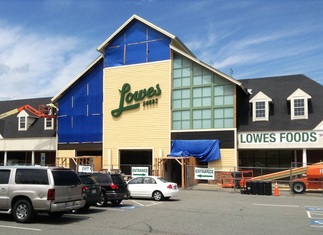
Lowes Foods, a 60-year-old, 100+ store grocery chain based in North Carolina, has made a gutsy move:  they’ve put the future of their business in the hands of their people.  Their team.  Their hosts -- the honorific says it all.  

The moment you walk in one of their rebranded, re-cultured stores, you can feel the difference.  Smiles seem to arise naturally.  Employees greet you and offer their help – and seem to mean it.  There’s a refreshing hustle about the place.  More spontaneity. Lowes Foods leadership has managed somehow to meld procedure and belief and make it work.  
 

“Cultural branding is really at the core, at the heart of what we’re trying to do,” says the company’s enthusiastic CMO, Michael Moore, a veteran of 28-years in the grocery business.  “And what I’ve experienced a lot as I’ve gone to retailers, both in the States and overseas, is that there’s so much emphasis placed on the visual side of the equation, prettying up the store, making it a little bit more shoppable, so on and so forth, but yet there’s nothing that’s done with what we call our hosts.”

Although stores like Publix (1077 stores in six southeastern states), Wegmans (84 stores in the Northeast), Whole Foods Market (371 stores nationally) and Nugget Markets (9 stores in California) are known for getting the cultural piece right.  And each rises continuously on FORTUNE’s list of the 100 Best Companies to Work For*. 

Nugget Markets claims that their “positive attitude and love of people” sets their associates apart, which – in turn -- sets them apart in the marketplace.

“Our associates are the difference maker,” says Chris Carpenter, their COO and Vice President, “and it is they who separate us from our competition.  We believe that when our associates are having fun and feeling valued, there is an energy and enthusiasm that is created—and it transcends right through the guest.”

Lowes Foods’ management gets that.  My recent conversation with CMO Moore in one of the company’s stores was interrupted several times by cheers from people in the Chicken Kitchen celebrating completion of another batch of “chicken you’d cross the road for.”  

Who wouldn’t rather shop at a store where people are enthusiastic about their work – as long as quality and selection are up to par?  Personal experience is just one of a dozen or so competitive factors that set any business apart – along with service, convenience, innovation, etc.  Even grocers who sell primarily on price often have other competitive factors in their favor.  Aldi for example, is known for its limited inventory, quality merchandise plus low price.

But the people part likely does as much, or more, to attract and hold customers than any other single competitive factor.  It’s also the most challenging to make happen -- and sustain -- in the me-saturated American culture.   Disney has proven the value (and endurance) of people power for decades.  

“The Disney operating style has greatly influenced our training program,” says Moore.  “We believe in one of the core Disney concepts in particular, which is when we’re on the floor we’re onstage, and we want the people onstage to be delightful.  We want our hosts to be rabid fans, working for Lowes, and we want our guests to feel that love – and feel that commitment and support.”

Even when my local Lowes Foods store was only halfway through its renovation, the cultural transformation already had begun taking hold.  I was pleasantly surprised when a man in the produce department engaged me in conversation about the mushrooms I was buying.  (see http://theproducemerchant.com/produce-stand-outs/ for more about him)

Customer satisfaction is relatively easy to achieve, because it’s … relative.  Creating delight, however, is quite something else and may not even be measurable except by collecting personal anecdotes and tracking repeat business. The man in produce delighted me by offering suggestions on how to store and prepare my mushrooms.  A month or so later, a young woman roaming the store with crisp watermelon samples intercepted me in the cereal aisle.  Her smile alone was enough to delight.  And had I not been a long-time Lowes Foods customer, either "host" would have more than counterbalanced my experience a few weeks prior with the only rude clerk I’ve ever encountered at that store (a memorable example of how not to treat a customer).

“Culture is the driver in our company in all departments,” says Lowes Foods VP of Fresh Sales Chris Van Parys.  “While the bricks and mortar have all evolved, of course, the take-away we have the most pride in is our people or hosts.  The main focus is taking care of our guests in new and unexpected ways.”

And not everybody fits. 

“There’s a certain profile we look for as we think about new hire strategy,” says Moore, “people comfortable with that kind of interaction.  The folks who are not, there’s tons of great backstage kind of work that fits better for them.  And we really make sure that’s front and center as people are making applications for jobs.”

The new people who have appeared in my local Lowes Foods store recently seem to embody that spirit more readily than the old crew (although there are a few choice holdovers).  Even the young workers who stock the shelves have sprouted an upbeat, helpful attitude.  You find much the same at Publix, where employees also are owners.


PictureImage © by Brian E. Faulkner
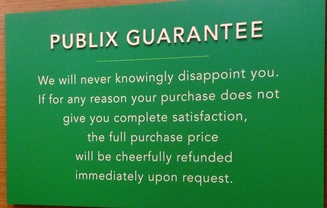
“Providing premier service and a pleasurable shopping experience is what we hang our hat on,” says Kimberly Reynolds, media and community relations manager in their Charlotte, N.C. division, who noted that as far back as 1930, their founder proclaimed that “we shall treat our customers like kings and queens.”  Today, how the Publix brand promise plays out in the stores remains their “secret sauce,” as an associate in Fort Mill, S.C. proved to me recently by not only being above-and-beyond helpful concerning a product they did not carry but personable to boot.  She personified founder George W. Jenkins' belief that "Publix will be a little better place — or not quite as good — because of you."

Max De Pree, in his seminal little book, “Leadership Is an Art”, talks about covenantal leadership, which I have seen at work in only a small handful of client organizations over the years – from small businesses to billion-dollar consumer products companies and their business units.  The culture of a national apparel manufacturer/marketer I consulted to revolved around a passionate leader who created the future, invested the team in it and sponsored their success.  But the company's culture proved tenuous.  When the leader moved on (or in another case  I recall, when corporate ownership changed), the cultural focus and inspired energy dissipated.

Lowes Foods, like Publix, appears to understand that in order to survive, qualities like “team” and “passion” and “commitment” can’t be pasted on.  They have to be planted deep and lived out in the attitudes and actions of people who believe they are contributing to a larger cause.  Only then can business culture become an enduring – rather than momentary – source of competitive advantage.  It’s not something you can fake.

Publix hires people with “a servant’s” heart, which CEO Ed Crenshaw appears to epitomize.  Lowes Foods hires people who understand the concept of “host” from the heart out, and their senior management team is quick to credit one another with the early success they’ve achieved in rebranding the chain and building a new culture.  That suggests stability in an era when grocery shoppers will change stores on a dime just to get a good price.   

Stability alone is no guarantor of success, of course, although stability based on a culture of believers with a can-do attitude can work wonders in attracting and keeping customers – and perhaps even help make a buck or two more than the competitor down the block. 

Publix and Lowes Foods are destined to compete more directly in the near future as the Florida chain moves deeper into North Carolina. Customers are sure to respond positively to both stores’ people-powered presentations and reward them with increased business and greater loyalty.

TakeAway: People power can be a powerful source of competitive advantage. How does your culture stack up?

Content © by Brian E. Faulkner   *FORTUNE and FORTUNE 100 Best Companies to Work For are registered trademarks of Time Inc.
Tags:  Lowes Foods, Publix, cultural branding, Wegmans, Whole Foods Market, Nugget Markets, ALDI


About Brian Faulkner:

Brian Faulkner is a content writer and Key Message expert.  He helps clients come up with words to set their businesses, brands and products apart and attract the customers they want most.  His strategic insights, and the words that go with them, have made a significant, often immediate difference for client companies over many years.  His "sweet spot" is smaller to moderate sized consumer products, retail, service and manufacturing companies that may have struggled to find just the right words to position their business, brands or products to competitive advantage:

>  blogs to establish you as the thought leader / authority in your business category
>  case stories that communicate your sales successes and invite prospect inquiry
>  testimonials that showcase customer / client satisfaction in 1-2 short sentences
>  positioning statements to guide business development & marketing
>  landing page copy to set your business or brand apart in a compelling way
>  tagline development to attract the interest of your most qualified prospects

Brian also is a three-time Emmy award-winning Public Television writer and narrator of over 100 segments for UNC-TV’s popular Our State magazine series, on the air since 2003.  


2 Comments

Creating Brand Advocates: A Marketing Lesson From the Piano WOrld.

7/7/2014

0 Comments

 
PictureImage © by Brian E. Faulkner
Pianos, especially grand pianos, have the misfortune to all look pretty much alike.  From ten feet away, it’s hard for most of us to tell the difference between one black grand and the next black grand.   The relatively uniform look from one instrument to another is what prompts makers like Steinway and Yamaha to emblazon their names on the sides of their concert pianos in very large letters, hoping that the audience’s eyes – not to mention TV cameras – will linger there a little longer.

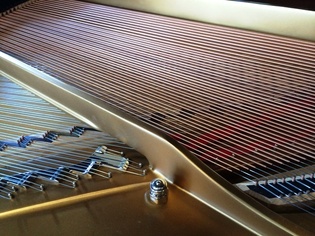
Go to a piano store and lift the lid on a grand of any size. Unless you are a true piano aficionado, for whom even the slightest difference between instruments can be an endless source of amazement and delight, you will find a golden plate (or harp) crisscrossed by an array of bronze and silver colored strings contained within a hefty case that makes that instrument look a lot like the one next to it. However, pianos are anything but alike in tone and touch, the primary criteria pianists use to evaluate the world’s best instruments – mostly hand-crafted in Europe but also including two premier quality holdovers from piano’s so-called golden age in the U.S., Steinway & Sons and Mason & Hamlin.  

Even so, top-tier piano makers typically describe their products in technical rather than tactile terms. Surprisingly, hardly any differentiate their instruments by their tonal palette.   

“To most piano buyers and owners,” writes Larry Fine in his publication, The Acoustical and Digital Piano Buyer, “a piano's tone is probably its most important aspect, but also the most difficult to quantify or describe.”

“There’s only so much that words can say about piano sound,” agrees Eric Johnson, a Registered Piano Technician and piano industry veteran with an MBA from Cornell who has prepped and tuned pianos for “some really great pianist in some really great concert halls,” including Carnegie, Avery Fischer, Alice Tully, Detroit, Chicago, LA, and San Francisco.   (http://www.ericjohnsonpianos.com/ )

“Differentiating one piano from another is a tough thing,” he says, “which is why copywriters so often fall back on design and build processes and brand history.”

So how do piano makers communicate their performance difference?  Mostly they don’t, knowing that playing and listening to pianos is largely a subjective experience.  They’re confident enough in their products to leave praise about tone and touch to the players of their instruments, people who are not shy with their opinions and likely will have gone through an exhaustive audition process before selecting their piano.  The makers then reflect the experience of these brand advocates back to the marketplace, where future buyers will read or hear the accolades.

But words mean different things to different people.

“You can say one piano is bright and another is warm, one is powerful, another is lyrical,” notes Johnson.  “But that distinction is made in the mind of the player.  I see that every time somebody tries to describe some uniquely personal combination of tone and touch they want me to coax from their instrument.”

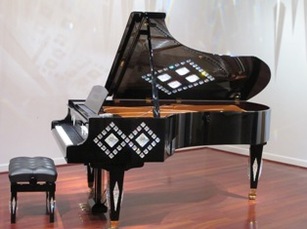
PictureArtcase Bösendorfer designed by glass artist Jon Kuhn
Of course, people purchase pianos for many reasons, including exotic veneers, intricate decorative work and prestige names.  But the deep difference between instruments truly becomes apparent when their 12-thousand or so parts begin to make music together. Until that happens, even the most lauded piano is just an expensive piece of furniture.  

The artists who make the music aren’t likely to mention how their piano’s hammers are made or point out whether the bridge cap grain runs vertically or horizontally.  But they can close their eyes and know what their piano sounds like.  They can hear it in their dreams … sometimes even before they find that “perfect piano.”

“It is uniqueness that I seek,” says acclaimed classical artist Valentina Lisitsa in praise of Vienna's famed Bösendorfer.  “Bösendorfer gives me a unique voice, unique palette of musical colors, unique tools to achieve my vision.”

Larry Fine describes Bösendorfer in more prosaic terms:  “Perhaps the world's most expensive piano inch for inch, Bösendorfer grands make an eloquent case for their prices. They are distinctive in both appearance and sound, and are considered to be among the finest pianos in the world.”

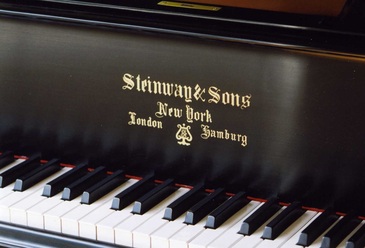
Picture1890s Steinway - Image © by Brian E. Faulkner
Emanuel Ax says this in praise of Steinway & Sons: "When one plays a Steinway, there is a warmth and nobility in the sound that is unequalled by any other instrument."

And here’s Fine’s take:  “Steinway pianos at their best have the quintessential American piano sound: a powerful bass, a resonant midrange, and a singing treble with plenty of tonal color. Although other brands have some of these characteristics, it is perhaps the particular combination of harmonics that comprise the Steinway's tonal coloration that, more than anything else, distinguishes it from other brands and gives it its richness, depth, and power.”

DO Your Customers SING YOUR SONG?

What is the marketplace saying about your business, brand, product or service?  

    > Do your customers or clients sing your praises?

    > Does what they have to say enhance or conflict with what you communicate in your tagline, marketing
       materials, advertising, positioning / capabilities videos and sales conversations?    

    > Do their words prompt others to want what you have, to experience your product’s performance for
       themselves? 

If you don’t know the answers to these questions, take a note from the world of high performance pianos -- and start listening.

TakeAway:  Customers can be your best brand advocates.  So can the people who write articles that your best prospects will read.  

Tags:  Steinway & Sons, Yamaha, Mason & Hamlin, Bosendorfer, Eric Johnson, Registered Piano Technician, Larry Fine,
The Acoustical and Digital Piano Buyer, Valentina Lisitsa, Emanuel Ax

Content © by Brian E. Faulkner
About Brian Faulkner:

Brian Faulkner is a content writer and Key Message expert.  He helps clients come up with words to set their businesses, brands and products apart and attract the customers they want most.  His strategic insights and the words that go with them have made a significant, often immediate difference for client companies over many years.  His "sweet spot" is smaller to moderate sized consumer products, retail, service and manufacturing companies that may have struggled to find just the right words to position their business, brands or products to competitive advantage:

>  blogs to establish you as the knowledge source / authority in your business category
>  case stories that communicate your sales successes and invite prospect inquiry
>  testimonials that showcase customer / client satisfaction in 1-2 short sentences
>  positioning statements to guide business development & marketing
>  landing page copy to set your business or brand apart in a compelling way
>  tagline development to attract the interest of your most qualified prospects

Brian also is a three-time Emmy award winning Public Television writer and narrator of UNC-TV’s popular "Our State" magazine series, on the air since 2003.  His distinctive sound has been heard on many hundreds of radio spots and client videos since the 1970s.  People say he has a "Mercedes voice" and sounds a bit like Charles Kuralt, which Brian considers a welcome ... but happy ... illusion.

0 Comments

High Flying DEALER Offers Car Purchase by Vending Machine.

6/25/2014

0 Comments

 
PictureYa think?
There are three kinds of car buyers.  One loves to kick the tires and joust with the dealership.  They are in the minority.  Another knows just what they want, has researched pricing and secured financing – possibly with a credit union.  This buyer shops dealers online and hones in on their transaction like a laser, taking delivery with limited exposure to dealer shenanigans.

But most of us still take the weary path, driving from car lot to car lot looking for the vehicle, price, trade-in allowance and financing package that either suits us or that we finally accept because we need a car and our patience has worn thin.

The second and third kind of car buyer, the traditional kind, now has another option – that is, if they live within reasonable driving distance of Atlanta (or can fly in): Carvana, a purveyor of late-model mid-market and luxury pre-owned vehicles that delivers buyer’s purchases through a novel “vending machine” not far from Georgia Tech. 

The vending machine concept (their storefront actually resembles one) sets Carvana apart from other online auto buying sources, as does an eye-pleasing, easy to navigate web site.  Prospects can even test drive their would-be purchases virtually before plunking down their bucks and showing up at the vending machine with an access code.  And if they need financing, that’s available, too -- the people backing the venture have years of experience running dealerships and in consumer finance.  All in all, Carvana seems organized for success, which begins with offering clear savings for its customers.

“The average consumer spends more than 20 hours and overpays roughly $3,500 when purchasing a car due to antiquated dealer sales practices,” declares a post on Carvana’s friendly and informative blog (http://blog.carvana.com/sample-page/the-back-room/).  That said, the firm claims to save $1,500 per car by not having a dealership, which they pass along to their customers.  A brief comparison of price on their Web site with those advertised for similar models with comparable mileage by dealerships in my area suggests that Carvana’s price is lower – a difference that could evaporate rapidly if a prospect has the time and patience to negotiate a better deal locally.  

Time and convenience are other Carvana differentiating factors, as is what they call a 7-Day Test Drive, essentially a post-delivery No Questions Asked Money Back Guarantee.

Customers can pick their car out from the comfort of their home, then fly/drive/walk to the company’s vending machine and take delivery there.  Inventory selection seems to consist mostly of silver and white 2011-2013 sedans or SUVs with the occasional red F-150, Mustang, Camaro or Jeep thrown in.  If they live within 75 miles of Atlanta, there’s free home delivery, or buyers can take delivery of their new ride in the traditional way.  For an additional $199, people who live within 76-250 miles of Carvana can have their new car trucked to them and delivered at home.  Buyers more than 250 miles away are invited to fly into Hartsfield and be picked up at the airport.

There would seem to be a vast market for the Carvana concept, since the typical car buying experience has been long due some transformation.  It isn’t the answer for everybody – maybe for most car buyers, people who like to see, touch and drive before they buy and who appreciate local service.   But all in all, it’s a refreshing concept that Carvana’s customers seem to like – witness this high compliment from a satisfied buyer, who said:

“If Apple invented a way to buy a car, this would be it.”

I admire this innovative idea -- and the visionary thinking that led to it.  I also appreciate Carvana’s spiffy online presentation and their copywriter, who has a mischievous (but restrained) sense of humor.  That could be the work of company president Ernie Garcia, if his recent blog post announcing future delivery of Carvana cars by helicopter is any clue.

A whole new way to buy a car?   Sure.  But I wouldn’t lay awake waiting on the helicopter.

TakeAway: Is there an idea lurking in your mind that could revolutionize your business category?      
Content © by Brian E. Faulkner

About Brian Faulkner:

Brian Faulkner is a content writer and Key Message expert.  He helps clients come up with words to set their businesses, brands and products apart and attract the customers they want most.  His strategic insights, and the words that go with them, have made a significant, often immediate difference for client companies over many years. His "sweet spot" is smaller to moderate sized consumer products, retail, service and manufacturing companies that may have struggled to find just the right words to position their business, brands or products to competitive advantage:

>  blogs to establish you as the knowledge source / authority in your business category
>  case stories that communicate your sales successes and invite prospect inquiry
>  testimonials that showcase customer / client satisfaction in 1-2 short sentences
>  positioning statements to guide business development & marketing
>  landing page copy to set your business or brand apart in a compelling way
>  tagline development to attract the interest of your most qualified prospects

PictureImage © by Brian E. Faulkner

Brian also is a three-time Emmy award winning Public Television writer and narrator of UNC-TV’s popular Our State magazine series, on the air since 2003. His distinctive voice has been heard on many hundreds of radio spots and client projects since the 1970s.  People say he sounds a bit like Charles Kuralt, which Brian considers a welcome but happy illusion.

(www.faulknerproducerservices.com)


0 Comments

The Airlines oR DMV - Which is Worse?

6/13/2014

0 Comments

 
PictureImage © by Brian E. Faulkner
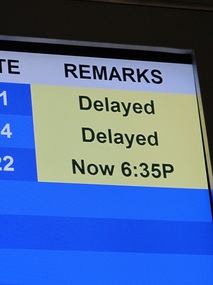
Flying commercial has been compared recently to waiting in line at the Department of Motor Vehicles office to register your car.   So which of the two has gotten so much worse that it invites the comparison?

Nearly every DMV wait I’ve experienced through the years has been annoying, hot, boring and lengthy, so not much has changed there.  In fact, I recall one especially memorable clerk in Connecticut back around 1970 whose snarl was genuinely world class.  She did not enjoy being helpful.  But most DMV clerks I’ve encountered have been helpful.  Just recently, a young woman here in North Carolina was not only helpful but pleasant as she sorted out my registration/ inspection mix-up, despite the long line of grumbly folks awaiting her attention.   

To be sure, life can dish out far greater unpleasantness than waiting in line at the DMV.   But the experience of traversing a busy airport these days apparently is running neck and neck with the DMV for customer dissatisfaction.

Flying used to be fun – back when airliners had propellers and you were eight years old and didn’t know any better.   In 2014, flying commercial (as distinct from renting or owning your own airplane and getting to fly whenever and wherever you want) can be a white knuckle experience, from the check-in line to the security line to the boarding crush to the two-hour delay on the tarmac to maybe getting to your destination on time or maybe not but still having to deal with the baggage crap-shoot no matter what.   Unless, that is, you're a passenger on Southwest Airlines, which has managed to fly above its competitors by offering a straight-ahead, efficient, value-priced product with fewer customer surprises.

Of course, in between the many hassles that greet the flying public today is the flight itself, which has morphed into a crammed-in-your-seat, uncomfortably public experience that nobody in their right mind would recall fondly unless they maybe lucked out and hooked a spot next to Harrison Ford or Angelina Jolie who had been forced to fly coach because this was the last flight out to East Sagebrush, Texas, where they were shooting a Western first thing in the morning.

Every business has its challenges, but some provide a greater sense of reward than others – compare the commercial airline business to selling flowers, for example.  The big challenge of flower selling may be running out of red roses, but as long as the stock holds, delivering bouquets of happiness can be fun.  Ideally, the airline business also should be about delivering happiness.  Instead, the challenge of most airlines these days appears to be annoying as few customers as possible.   Although I’ve never done it, selling flowers seems like it might be a pleasure compared to working an airline ticket counter.

From the time you go online to buy your ticket to the time you and your fellow passengers have to wait as some unthinking clod attempts to stuff his slightly oversized carry-on into the slightly undersized overhead bin while the harried flight attendant tries to introduce some discipline, pleasure is not usually what comes to mind when thinking about commercial air travel, with its ever-skinnier seats and the exorbitant fee they charge to make sure your extra suitcase actually gets on the plane with you.  I’ve even read lately that some airlines are considering shorter lavs to save space – you don’t mind bending over to do your mid-air business, do ya?  

It makes you wonder, What are they thinking?! when airlines slight passenger comfort or convenience to shave a buck or two off their fares.

“Offering our low fares requires doing some things that some people complain about,” Spirit CEO Ben Baldanza recently wrote in a letter to Bloomberg Businessweek, “—more seats on our planes with a little less legroom, no Wi-Fi or video screens, and no refunds without insurance; however, these reduce costs which gives our customers the lowest fares in the industry.  Judging by the number of customers on our planes and repeat customer rate,” he concluded, “most people like this tradeoff.”

This strikes me as long-range customer service suicide. 

So back to the comparison between flying and the DMV. 

“Forty-two percent rated the DMV as worse than a busy airport, while 40 percent said being in a packed airport is worse than standing in line to get a new driver's license,” according to an article by CNBC.com’s auto and airline industry reporter, Phil LeBeau.  "No doubt the airline industry is doing a better job of pleasing passengers, but there still is a lot of room for improvement," LeBeau writes, quoting J.D. Power's Rick Garlick. "Satisfaction is improving, but it's a stretch to say passengers are truly happy."

Now there’s an understatement.  

It’s also an understatement to say that the airline business is tough and complex.  Margins are thin at best and beset by high fuel costs and other profit-munching expenses.  As Richard Branson so wryly put it, "How do you become a millionaire?  Start as a billionaire and then buy an airline.”

Even so, the knack of the airline business to rile up its customers astonishes me no end, despite the often herculean efforts of individual employees to do the opposite.   In light of this unfortunate reality, I have created a pair of taglines to dramatize the difference between the two nearly equal customer service experiences.

DMV Tagline:  Bear with us, it will be over in 15-20 minutes.

Commercial Airlines Tagline:  Bear with us, it will never be over – and have a nice flight.

TakeAway:  When the service in your industry descends to joke status, there’s an opportunity for somebody to  break the mold and create real competitive advantage.  Will that be you … or your competitor?  

Content © by Brian E. Faulkner


About Brian Faulkner:

PictureImage © by Brian E. Faulkner
Brian Faulkner is a Key Message expert.  He helps clients come up with words to set their businesses, brands and products apart and attract the customers they want most.  His strategic insights, and the words that go with them, have made a significant, often immediate difference for client companies over many years. He thrives on strategic communication problem solving, complex subjects, new ideas, concepts-as-products, challenging marketing situations and demanding deadlines.  His "sweet spot" is smaller to moderate sized consumer products, retail, service and manufacturing companies that may have struggled to find just the right words to position their business, brands or products to competitive advantage.


Brian also is a three-time Emmy award winning Public Television writer and narrator of UNC-TV’s popular Our State magazine series, on the air since 2003.  


0 Comments

Krispy Kreme's Lost Love.

6/7/2014

0 Comments

 
PictureImage © by Brian E. Faulkner
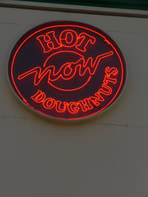
Krispy Kreme is more a dream than a donut.  Anybody who’s ever tasted one knows it.  Whether last week, last year or a lifetime ago, a hot-from-the-shop Krispy Kreme donut is one of the few things you can experience the first time all over again.  Even first kisses fade, but Krispy Kreme lingers.

Once you’ve encountered this exquisite life’s experience masquerading as a donut, you don’t forget.  And look forward to your next first taste.

So what’s up with the erratic market performance of this iconic American brand?  Sure, management stumbled a few years back and had to retrench.  Sure, the shrill voices of the sugar police rose against them – not to mention the carb patrol and the trans-fat fighters.  The Great Recession also hurt the company (stand in line).  But here’s what truly ails Krispy Kreme:

They’ve lost the threads of their brand story.

Krispy Kreme used to have it made.  People loved the delectable treat with the power to steal their hearts, and the Winston-Salem, North Carolina company was the rising star of donut retailers with a share of mind that outdistanced even its much bigger rival, Dunkin’ Donuts.  Up until about ten years ago, they rode a wave of popularity that bordered on cultishness.  Entering the 21st century, it looked like Krispy Kreme could do no wrong.  Its franchises were costly but promised a stellar return on investment and guaranteed an enviable place in America’s popular psyche (picture here the mythological Psyche, object of Cupid’s desire).   

One new store in Washington State, where the mythical appeal of Krispy Kreme’s awful goodness had stirred up a willing crowd, was said to have grossed $454,000 in the first week.  By comparison, the average McDonald’s at the time (around 2004) was generating approximately $1.5-million in sales annually.  It wasn’t unusual for a new store to attract long lines of people patiently waiting to become Krispy Kreme customers.  But not any more.  Today’s new store openings have to promote “free donuts for a year” to attract a crowd that used to come unbidden.

The company seems to have gone a long way toward fixing their organizational and financial issues, despite the latent skepticism that dogs them on Wall Street.  Much is reported about their stock price performance and management changes these days, but there’s little talk of Krispy Kreme the brand, the Pied Piper of donuts, whose products should be liberally passed around the mighty New York investment houses early every morning, accompanied by cups of Krispy Kreme’s excellent coffee.  That would turn ‘em around!  Even the stubbornest of sugar deniers among them would succumb quickly upon experiencing the first-time pleasure of each warm Krispy Kreme signature glazed donut (a hot Krispy Kreme is heavenly; a cold one is just different).
 
So is there magic still left in Krispy Kreme?  As one who lives near their headquarters and has watched the company’s fortunes rise and fall for a long time, I hope so. The brand may still live in our hearts, but it’s up to Krispy Kreme to remind us from time to time -- to keep telling their story.

TakeAway:  If you have a brand people love, treat it like the rare treasure it is, lest it tarnish and fade away.
Tags:  Krispy Kreme, Dunkin’ Donuts

Content © by Brian E. Faulkner
About Brian Faulkner:

Brian Faulkner is a content and strategic communication writer.  He helps clients come up with words to set their businesses, brands and products apart and attract the customers they want most.  His strategic insights, and the words that go with them, have made a significant, often immediate difference for client companies over many years.  He thrives on strategic communication problem solving, complex subjects, new ideas, concepts-as-products, challenging marketing situations and demanding deadlines.  His "sweet spot" is smaller to moderate sized consumer products, retail, service and manufacturing companies that may have struggled to find just the right words to position their business, brands or products to competitive advantage.

Brian also is a five-time Emmy award winning Public Television writer and narrator of UNC-TV’s popular Our State magazine series, on the air since 2003.  

0 Comments

Starbucks And The Battle For Your Mind.

6/5/2014

0 Comments

 
Picture
Starbucks is scary good at making you want to do business with them.  All you’ve got to do is walk in the place and you want to be there.  And maybe have a three-buck cup of coffee or perhaps one of those frothy espresso things while you linger with friends or tap away on your tablet.  But that’s not the point: Starbucks is mostly about the experience. 

​They also sell coffee.

Starbucks has become a cultural big deal.  Their cafes are social gathering spots all over the world, a big reason why the company’s share of the coffeehouse market is so mind-boggling. 

And what’s so eerily sensible about Starbucks’ marketing strategy is how little they spend on advertising compared to some big-time competitors -- and how much they invest in getting the experience right, from product to the people who present the product. 

When was the last time you saw a Starbucks ad on TV?  Compared to McDonalds or even Dunkin' Donuts (both of whom seek to amp up their coffee business), Starbucks’ investment in advertising is miniscule.   They don't need advertising, which Geek Squad founder Robert Stephens calls “a tax you pay for unremarkable thinking.”  Because Starbucks has what I call Word of Mind.  Their brand lives in your head. 

When it’s time to socialize over a cup of coffee – and you’re a man or woman between 25 and 40 (their demographic sweet spot), you think about Starbucks first.  Or one of the gazillion local coffee shops that emulate Starbucks’ atmosphere if you can’t find the real thing. The idea here is not to diminish your favorite coffee haunt in favor of Starbucks but to point out the power in getting the basics right: creating a product experience that lives in your customers’ minds.  It doesn’t matter what you sell – office supplies or church chairs, underwear or industrial components.  Your “real” product may be something quite apart: the experience of using or wearing or drinking what you sell.  

Picture
Have you noticed?

Starbucks’ logo doesn’t even say “coffee” anymore.  It’s just that smiling mermaid singing her Siren song about the atmosphere and sense of social connectedness that Starbucks sells along with their coffee. 

TakeAway:  The battle for your customers’ minds may lie more in product experience than product features.

Tags:  Starbucks, McDonalds, Dunkin' Donuts, Geek Squad
Content © by Brian E. Faulkner

About Brian Faulkner:

Brian Faulkner is a content writer and strategic communication consultant.  He helps clients come up with words to set their businesses, brands and products apart and attract the customers they want most.  His strategic insights, and the words that go with them, have made a significant, often immediate difference for client companies over many years.  He thrives on strategic communication problem solving, complex subjects, new ideas, concepts-as-products, challenging marketing situations and demanding deadlines.  His "sweet spot" is smaller to moderate sized consumer products, retail, service and manufacturing companies that may have struggled to find just the right words to position their business, brands or products to competitive advantage.

Brian also is a five-time Emmy award winning Public Television writer and narrator of UNC-TV’s popular Our State magazine series, on the air since 2003.  

0 Comments
<<Previous
Forward>>


    sample blog:

    This is a sample blog  for writer Brian E. Faulkner.  It presents stories about brands that do (or don't) communicate competitive advantage effectively. Stories have been gleaned from the business press, personal experience and occasional interviews. New articles are added from time to time, and every so often there will be a post of general interest -- about things like success, passion, social trends, etc. 

    Author

    Brian Faulkner is a writer and strategic communication consultant who helps business clients explain their competitive advantage in compelling and enduring ways.
     
    He also is a five-time Emmy award winning Public Television writer & narrator for a highly-rated and well-loved magazine series.

    Picture
    Image © by Brian E. Faulkner
    Categories

    All
    Advertising
    Authenticity
    Brand Branding
    Brand & Branding
    Brand Names
    Business Culture
    Competitive Advantage
    Competitive Advantage
    Competitive Factors
    Content
    Creativity
    Culture
    Customer Satisfaction
    Differentiation
    Experience
    Flexibility
    Future
    Innovation
    Key Message
    Leadership
    Luxury
    Marketable Truth
    Marketing
    Passion
    Politics
    Positioning
    Price
    Quality
    Sales
    Service
    Small Business Marketing
    Story
    Strategic Thinking
    Taglines
    Team
    Technology
    Trends
    Values
    Vision

    Archives

    July 2019
    January 2019
    November 2016
    February 2016
    October 2015
    September 2015
    August 2015
    July 2015
    June 2015
    May 2015
    April 2015
    March 2015
    February 2015
    January 2015
    December 2014
    November 2014
    October 2014
    September 2014
    August 2014
    July 2014
    June 2014
    May 2014
    April 2014
    March 2014
    February 2014
    January 2014
    December 2013
    November 2013
    October 2013
    September 2012
    October 2011
    March 2011

    RSS Feed

Content © by Brian E. Faulkner.   All rights reserved.