A BLOG ABOUT COMMUNICATING COMPETITIVE ADVANTAGE
  • Brian Faulkner
  • Blog
  • CONTACT

Does Coach Have An Image Problem?

1/8/2015

0 Comments

 
PictureImage © by Brian E. Faulkner
Got to thinking about Coach, Inc.’s brand image today after reading an article that questioned the company’s potential acquisition of fashion footwear brand Stuart Weitzman to complement their own nascent shoe line, reportedly the first of an array of “lifestyle” products to take them beyond handbags. 

Krystina Gustafson speculates in her CNBC.com article that, while Weitzman will add to overall Coach sales, it may not do much for the brand’s image, which needs some propping up.  She also quotes Robert Konik, an analyst with the global investment banking firm Jeffries, who suggests (in a note to investors) that Coach has, indeed, lost some of its pricing power. 

The brand may have at long last fallen out of favor with high end shoppers, Gustafson adds, because of “stale product, over-distribution and damaged brand equity from its high presence at outlet malls.”

Back in the late ‘80s, I helped their president, Lew Frankfort, with a Coach positioning speech he presented to an audience of marketing and sales reps.  Frankfort led development of the Coach business from the early ‘80s until his retirement late last year as executive chairman, during which he was instrumental in expanding the fashion leather handbag’s company’s revenue and global footprint by many orders of magnitude. 

My brief connection with him occurred during the company’s Sara Lee days, when the Chicago-based food and apparel giant was making acquisitions and launching initiatives in direct retail.  The corporation’s desire back then, via their Sara Lee Direct division, was to maximize the potential of its well-known brands, and what they discovered through research (if I recall correctly, conducted by McKinsey) was that if Coach products were sold in high end department store boutiques as well as Coach-owned retail stores, aggregate sales would increase.  That appears logical enough at first glance, but the fear was that department store sales would eat into Coach store sales – and begin eroding their price premium.  At that time, their flagship Manhattan store was said to do more sales per square foot than any other retailer in America.

But department store sales of Coach bags did not cannibalize sales in the company’s own stores.  And soon, the logic went, why not try outlet malls, since Sara Lee Direct already was knee deep in building off-price stores for its Hanes, L’eggs and Bali brands.  So Coach stores began turning up at the better outlet malls, a presence that remains today.

But there’s the rub.   Without denying the considerable growth of Coach, Inc. over the years, a portion of which clearly must have come from its outlet mall business, one does wonder whether their exalted brand name has been diminished by its continued presence in discount retail settings, where the merchandise isn’t always the same as that you’d find in New York, Beverly Hills or Tokyo.  For instance, in the third quarter of 2010, “87-percent of the merchandise at Coach outlet stores was manufactured for the outlet,” according to a 2011 article at palmbeachpost.com. “The rest was made up of items that came from the retail stores - perhaps excess inventory, or returns, or items that were no longer in season.”

“The outlet bag is just not the same quality, won't have the same details, as the one at the retail store for $1,200," noted Howard Davidowitz, chairman of national retail consulting and investment banking firm Davidowitz & Associates Inc., in the article -- although you still can cop a deal at your nearest Coach outlet store from time to time.  “A pink Mia handbag from Coach’s Madison collection was found on discount for $175 recently at the Vero Fashion Outlet," the same article noted,"plus an additional 20 percent off that was being offered on everything in the store for a final price of $140. That same handbag was available by special order at the Coach retail store in The Gardens Mall — still at the full original price of $358.”

Even so, I must admit that seeing a Coach store in an outlet mall these days rather disappoints me.   

The CNBC article notes that a pair of Stuart Weitzman pumps sell at a considerable premium over a Coach branded pair (assuming equal product style and quality, one would think).  So apparently Coach does, indeed, have some pricing headroom to make up because of the downward pull on their premium image, an opportunity that they’ve created for themselves by associating the brand with outlet settings for so many years.  

Meanwhile, I will continue to enjoy use of the Coach Bleeker Flap Briefcase I acquired back in the ‘80s.  It’s been through the wars -- including one minor flood that devastated its contents, and it still looks and performs great.  Let’s hope the company’s image does that well over the long run as Coach grows into those “lifestyle” products.

TakeAway:  If you’re marketing a premium product, stick with a price that commands -- and builds on -- your brand’s premium positioning.   

For additional discussion about sticking to premium product pricing, using Godiva chocolates as an example:  http://www.brianefaulkner.com/blog/godivas-alluring-words-enduring-promise  

Content © by Brian E. Faulkner

Sources:  http://www.cnbc.com/id/102314069
http://www.palmbeachpost.com/news/business/outlet-stores-are-you-getting-a-good-deal-or-just-/nLpgZ/


0 Comments

THe Real Thing: (not Coca-COla)

12/20/2014

0 Comments

 
PictureImage © by Brian E. Faulkner
Popped into a music store yesterday to buy a gift for my guitar-playing son and hadn’t been there more than a minute before I spied what looked at first glance like a Martin D-45 marked down to around $300.  If so, that would be the deal of the century, and should I have stumbled on such a rarity, its purchase, no doubt, would have made me feel less bummed over having sold my '63 Martin 00018 twenty years ago to buy an alternator for my old Chevy Celebrity.

The D-45, for those not acquainted with premium-quality guitars, is C. F. Martin’s flagship model, complete with abalone inlays, fancy purfling, East Indian rosewood sides and back and a sound that stands up and speaks with both sweetness and authority. 


The pretender in that guitar shop didn’t even come close, although it did have some attractive inlay work.  Apparently, a previous shop owner (now deceased) had a bunch of guitars made up in Korea to look like the best of the best American instruments and had his name put on them.  The guitar on display was one of the few would-be Martins or Gibsons or Fenders that hadn’t been sold over the years.

Guitars, like pianos, invite you to play them – or not.  It’s either a match made in heaven or a block of wood with strings on it (a guitar-shaped object, as the derision goes).   This particular guitar felt heavy, played thick and did not sing.  It was more of a decoration than a serious musical instrument – something you’d hang on the wall of a Nashville-themed restaurant.

Brands are a lot like that.  The best ones sing.  They wrap you into an experience that you look forward to – whether you buy a product for pleasure, utility or both (like the Black & Decker rechargeable lawnmower I finally bought last year).  I never have been much of a guitarist, but I always looked forward to playing my Martin.  I liked its song.  And it made me feel more accomplished than I actually was.   

I paid $300 for that guitar in 1970.  Today, it would bring around $3,000, maybe more.  A big D-45 from the same era could fetch upwards of twice that (the first one was custom made for Gene Autry in 1933).  These days, MSRP on a D-45 fresh from Nazareth is close to $11,000 -- and worth every dime.

I once had an acquaintance with a D-45 for sale.  He advertised it in the classifieds (in the part of North Carolina where a D-45 could be considered a six-string holy grail).  No takers.  So he doubled the price.

It sold lickety-split!  That guitar was the real thing – and (finally) priced accordingly.

It’s tempting to suggest that in order to sell something lickety-split it needs to sing like a Martin D-45 and be as costly, but ain't necessarily so.  A satisfying experience (like I used to get from my old Martin 00018 and still get from my lawnmower) can occur in all product categories and at all price levels. With guitars, that ranges from collector instruments on down through a student’s first guitar, which should NOT be a block of wood but have a sound that draws the ear in and strings that play with enough ease to encourage.  Too many parents make the mistake of buying a “bargain” instrument for their child to learn on and then wonder why the thing ends up stuck back in the closet after a couple of months. 

Quality, of course, can be maddeningly difficult to get a grip on.  One of my least favorite definitions is the industrial-bland “conformance to requirements.” 

Bah!

True quality should delight and amaze.  It should make you want what it’s got, whether resident in a fine guitar, a beautiful set of gears for a transmission or something as simple as a flashlight that feels good and works every time, a tool that you can use with confidence while searching for that old guitar you know must be back there in the closet somewhere …

TakeAway:  Be the real thing, the brand or product that people look forward to using (or building into the things they make) – no matter what you’re selling.

Content © by Brian E. Faulkner 


0 Comments

A Small Steinway With A Big Message.

11/4/2014

0 Comments

 
Picture
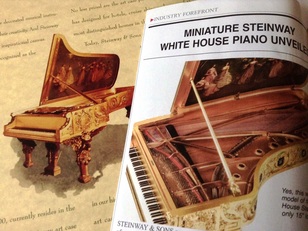
Flipped through the November Music Trades magazine the other day and came upon a picture of a miniature art case piano based on an elaborate Steinway given to the people of United States during the first Roosevelt administration.  Detailed marquetry on its side portrays the thirteen original American colonies, while nine lavishly painted muses adorn the underside of the lid. 

From intricate carvings to ornate legs, the 1903 White House Steinway (now at the Smithsonian’s National Museum of American History) is a richly decorated example of turn-of-the-previous-century piano design and craftsmanship.

But this White House Steinway – the one in the magazine -- isn’t a real Steinway.  Is it?

Steinway says it is – and has declared it so.   But this Steinway is only 15-inches long.  You could probably hold it in your outstretched hands (if they let you).   It’s priceless.  And perfectly proportioned, down to the most obscure piano detail.   It’s not a model.  It’s a “real” Steinway, according to the company.

As piano folks say, it’s actionable.  It plays!

Each tiny key, wippen, hammer, damper, string and bridge pin works in perfect synchrony with all the other 12,115 grand piano parts to produce real musical notes.  A Lilliputian pianist could sit her miniature self down on the instrument’s gilded stool, lift the fallboard and play a concert!  And it probably would sound good (in a smallish sort of way), although the article doesn’t say that. 

The 1:7 scale Steinway was created by Canadian artist Paul Gentile, who is famous for making other astonishingly accurate small scale musical instruments.  In his quest for perfection, he even fashioned a small version of Steinway’s 19th century rim press to help create the piano’s case (it wouldn’t surprise me if he used precisely the number of hard rock maple laminates and the correct glue and procedure to assure authenticity).  He even had Steinway’s foundry cast the instrument’s golden plate.

His particular genius and level of obsession clearly qualify Gentile to make a piano, one of the most exacting (and emotionally gratifying) undertakings in the world.  

Of course, Steinway has created instrument after instrument for more than 160 years, ever since the company’s German immigrant founder, Heinrich Engelhard Steinweg, built the first one in his Manhattan kitchen.  To this day, each Steinway has an individual allure that must be matched to the player, although all Steinways share the same exalted pedigree.

Gentile’s gilded miniature, apparently, is no exception.

But what’s so eminently instructive about the mere existence of this miniature art case piano is the gilded reputation Steinway & Sons has crafted for itself over the years.  Through times of uncertainty and change, they have built their brand on a foundation of excellence, as described initially by the man who became known as Henry Engelhard Steinway.

“Build the best piano possible,” he instructed.  Then “sell it at the lowest price consistent with quality.” 

That price has continued to rise, to the point where a Steinway concert grand can set you back around $150,000 (closer to  $200,000 with certain veneered cases).  Steinway prices increase by a predictable chunk every year, but there’s no shortage of discerning buyers willing to invest in new Steinways or plunk down the cash for quality rebuilt ones, especially those restored in the company's own shop.

Quality is a difficult notion to put your finger on because it’s experienced in the eye (or ear) of the beholder.  Even so, through a combination of old world craftsmanship and diligent brand building over the years, Steinway & Sons pianos have managed to become the quality standard to which others are most often compared – particularly at the concert performance level, whether the grand on stage is a New York Steinway or a Hamburg Steinway.  Of course, other exquisitely-crafted pianos from low volume (mostly European) makers also are available to performers, each with its unique appeal and devotees.  But there’s still only one Steinway.

It’s just that now one of them is very, very small.

TakeAway:  Build your brand brick by authentic brick.   In time, perhaps you can become the standard by which your competitors are judged.  And maybe then some famous artist will take the time to honor you by creating a working miniature of your product.


0 Comments

High Flying DEALER Offers Car Purchase by Vending Machine.

6/25/2014

0 Comments

 
PictureYa think?
There are three kinds of car buyers.  One loves to kick the tires and joust with the dealership.  They are in the minority.  Another knows just what they want, has researched pricing and secured financing – possibly with a credit union.  This buyer shops dealers online and hones in on their transaction like a laser, taking delivery with limited exposure to dealer shenanigans.

But most of us still take the weary path, driving from car lot to car lot looking for the vehicle, price, trade-in allowance and financing package that either suits us or that we finally accept because we need a car and our patience has worn thin.

The second and third kind of car buyer, the traditional kind, now has another option – that is, if they live within reasonable driving distance of Atlanta (or can fly in): Carvana, a purveyor of late-model mid-market and luxury pre-owned vehicles that delivers buyer’s purchases through a novel “vending machine” not far from Georgia Tech. 

The vending machine concept (their storefront actually resembles one) sets Carvana apart from other online auto buying sources, as does an eye-pleasing, easy to navigate web site.  Prospects can even test drive their would-be purchases virtually before plunking down their bucks and showing up at the vending machine with an access code.  And if they need financing, that’s available, too -- the people backing the venture have years of experience running dealerships and in consumer finance.  All in all, Carvana seems organized for success, which begins with offering clear savings for its customers.

“The average consumer spends more than 20 hours and overpays roughly $3,500 when purchasing a car due to antiquated dealer sales practices,” declares a post on Carvana’s friendly and informative blog (http://blog.carvana.com/sample-page/the-back-room/).  That said, the firm claims to save $1,500 per car by not having a dealership, which they pass along to their customers.  A brief comparison of price on their Web site with those advertised for similar models with comparable mileage by dealerships in my area suggests that Carvana’s price is lower – a difference that could evaporate rapidly if a prospect has the time and patience to negotiate a better deal locally.  

Time and convenience are other Carvana differentiating factors, as is what they call a 7-Day Test Drive, essentially a post-delivery No Questions Asked Money Back Guarantee.

Customers can pick their car out from the comfort of their home, then fly/drive/walk to the company’s vending machine and take delivery there.  Inventory selection seems to consist mostly of silver and white 2011-2013 sedans or SUVs with the occasional red F-150, Mustang, Camaro or Jeep thrown in.  If they live within 75 miles of Atlanta, there’s free home delivery, or buyers can take delivery of their new ride in the traditional way.  For an additional $199, people who live within 76-250 miles of Carvana can have their new car trucked to them and delivered at home.  Buyers more than 250 miles away are invited to fly into Hartsfield and be picked up at the airport.

There would seem to be a vast market for the Carvana concept, since the typical car buying experience has been long due some transformation.  It isn’t the answer for everybody – maybe for most car buyers, people who like to see, touch and drive before they buy and who appreciate local service.   But all in all, it’s a refreshing concept that Carvana’s customers seem to like – witness this high compliment from a satisfied buyer, who said:

“If Apple invented a way to buy a car, this would be it.”

I admire this innovative idea -- and the visionary thinking that led to it.  I also appreciate Carvana’s spiffy online presentation and their copywriter, who has a mischievous (but restrained) sense of humor.  That could be the work of company president Ernie Garcia, if his recent blog post announcing future delivery of Carvana cars by helicopter is any clue.

A whole new way to buy a car?   Sure.  But I wouldn’t lay awake waiting on the helicopter.

TakeAway: Is there an idea lurking in your mind that could revolutionize your business category?      
Content © by Brian E. Faulkner

About Brian Faulkner:

Brian Faulkner is a content writer and Key Message expert.  He helps clients come up with words to set their businesses, brands and products apart and attract the customers they want most.  His strategic insights, and the words that go with them, have made a significant, often immediate difference for client companies over many years. His "sweet spot" is smaller to moderate sized consumer products, retail, service and manufacturing companies that may have struggled to find just the right words to position their business, brands or products to competitive advantage:

>  blogs to establish you as the knowledge source / authority in your business category
>  case stories that communicate your sales successes and invite prospect inquiry
>  testimonials that showcase customer / client satisfaction in 1-2 short sentences
>  positioning statements to guide business development & marketing
>  landing page copy to set your business or brand apart in a compelling way
>  tagline development to attract the interest of your most qualified prospects

PictureImage © by Brian E. Faulkner

Brian also is a three-time Emmy award winning Public Television writer and narrator of UNC-TV’s popular Our State magazine series, on the air since 2003. His distinctive voice has been heard on many hundreds of radio spots and client projects since the 1970s.  People say he sounds a bit like Charles Kuralt, which Brian considers a welcome but happy illusion.

(www.faulknerproducerservices.com)


0 Comments

Auto Lust -- The Brand in My Mind.

5/31/2014

0 Comments

 
Picture
I was driving I-95 north of Petersburg with no particular thoughts in mind when it came up behind me: a silver slyph of a car I couldn’t identify in the rear view mirror.  

As it pulled around to pass my yellow Ford Galaxie, I read the badge on its side:  Datsun 240Z, and watched hungrily as the new object of my desire eased ahead and then vanished in the haze that hung over Richmond.  I caught sight of the car once more, at a toll booth. 

Then it was gone.

Needless to say, I was smitten.  And immediately on returning to North Carolina I placed my order for one – that is, I added my name to the waiting list.  Then, as sure of himself as a young man can be, I waited with considerable lack of patience for my car to come in.

Six months or so later, the phone rang.  I arrived at the dealership to look at the car that could have been mine with a mixture of awe and disappointment, since I didn’t have the money to pay for it – just over $3,000, as I recall.  

A much older man today, I savor the memory of that young man’s moment.  Not the auto lust that arose at first sight of the car that day in Richmond but the decision moment that came later as real-life priorities asserted themselves, priorities that did not include borrowing money I didn’t have to buy a car I couldn’t afford – I’d done too much of that already.   It was time to settle down, and with that in mind, I no longer lusted after the Zs that flashed by me on the Interstate.

Now flash forward more than forty years to an article I came across about the “new” Datsun 240Z, a hope born in dreams that never totally got off the ground, although plenty of grown men with auto lust in their hearts seemed willing to spend themselves silly trying. 

It was the mid ‘90s.  Nissan, the Japanese car company known for a while in this part of the world as Datsun, had stopped production of their latest Z car iteration, and since a new one was still in design, decided to fill the gap with a bold and inventive marketing move.  

First step was to buy up all the ’70 and ’71 240Zs they could find that were in good enough shape to rebuild (primary from the desert states).  And the next step was to enlist the help of a handful of Southern California restoration shops that would dismantle and restore the cars – a process more akin to remanufacturing than restoring.  Every nut and bolt was either reconditioned or replaced, including interior parts, engine and transmission; only the brake pads, some suspension pieces and tires were upgraded to meet current code.  Nissan even supplied a plaque commemorating 26 years of the Z-car to be affixed to each “new” 240Z.

This time the price tag was $25,000, which increased to more than $27,000 before the project was abandoned after only 40 of 200 cars were produced.  Apparently there weren’t enough takers.  

Of course, I didn’t know anything about this in 1996 when the remanufactured cars were first offered for sale.   Good thing, because life at that moment did not offer any spare change for an indulgence like the authentic … lustworthy … new … silver … Datsun 240Z that Nissan would have tempted me to buy.  

It’s an amazing story.  (http://jalopnik.com/what-happened-to-all-the-datsun-240zs-nissan-restored-i-1583370936).   What's even more amazing, however, is how the image of that silver car from that day so long ago still lives in my mind.  But isn’t that what brand is about, whether you’re selling an alluring sports car or making the best strawberry jam on the planet?  

The most lasting brands are images.  They are ideas that stick to your being.  And will not be dislodged by anything short of calamity. 

Brand is experience writ large.  And for a few short years, Datsun got it right.

TakeAway:   Does your brand live in the minds of your prospects and customers?   If not, how can you make it that way?

Content © by Brian E. Faulkner

About Brian Faulkner:

Brian Faulkner is a Key Message expert.  He helps clients come up with words to set their businesses, brands and products apart and attract the customers they want most.  His strategic insights, and the words that go with them, have made a significant, often immediate difference for client companies over many years.  He thrives on strategic communication problem solving, complex subjects, new ideas, concepts-as-products, challenging marketing situations and demanding deadlines.  His "sweet spot" is smaller to moderate sized consumer products, retail, service and manufacturing companies that may have struggled to find just the right words to position their business, brands or products to competitive advantage.
Picture

Brian also is a three-time Emmy award winning Public Television writer
and narrator of UNC-TV’s popular Our State magazine series,
on the air since 2003. 

0 Comments

Best Buy Fails To Satisfy: Poor Customer Experience Suggests Need For Strategic Change.

4/8/2014

2 Comments

 
PictureBest Buy image.
Went shopping for a new laptop last weekend at Best Buy.  Over the years, I have avoided Best Buy because it’s too big and sometimes too loud and because the help doesn’t always know what they’re talking about.  Truth is I don’t like big box stores in general.  I miss the small, more specialized, more personable shops (and shopkeepers) that used to populate our towns and cities. 

But if I want a wide variety of laptops to select from – at least in Piedmont North Carolina, there is no choice other than to frequent Best Buy, or one of the office boxes. 

So there we were, two somewhat older, would-be Best Buy customers wandering around trying to figure which laptop from a mind-numbing array of choices would best suit my wife.  Within minutes, a young guy in a blue Best Buy shirt appeared, briefly inquired about our needs and said he’d find someone to help us out – a positive start!  Then he (and apparently his helper) … disappeared.   Later, after having selected an HP laptop totally on our own, he approached us again as we sauntered over to the camera department and went through the same routine again, not realizing that he had spoken to us fifteen minutes earlier.

In the camera department, I asked another blue-shirt about a specific Canon product that they were likely to have in stock considering the price range of cameras already on display.  “No,” the clerk said.  “We don’t have that one.”  He wandered off.

Hmmm …

Then I turned around, and there – at eye level on an end cap display – was the camera I’d inquired about in all its promotional glory!

The clerk came back.  I pointed out the display.  He seemed genuinely shocked.  Then said that the camera department “expert” would be back from lunch in a few minutes and that we should hang around and talk to him.   We did.   He didn’t.   After a while, the clerk returned with news that the expert wasn’t actually working that day and that we should come back during the week.

Hmmm …

So on to checkout.  Only one register open, and there was a line.   After a while, it was our turn.   The young woman behind the register acted bored beyond hope and asked far too many pre-programmed questions, which was one reason the line moved so slowly.   After completing our single-item transaction, her final note of disdain was to mutter “Thank you, have a great day” in a tone that made me want to dope-slap her (or her manager, or his/her manager, or the president of the company).

One miscue I can handle, but five?

1.  The disappearing greeter, Part I.

2.  The disappearing greeter, Part II.

3.  The uninformed camera clerk.

4.  The missing expert.

5.  The disappointing checkout.

HEY BEST BUY People, IT SHOULDN'T Be That Difficult!

Best Buy had five chances to shine but muffed them all.   Sure, the company is having trouble finding its way in a world that’s getting more expansive on one hand (think Amazon.com) and more specialized on the other (think Apple stores).   If they don’t reinvent themselves – and soon, upstart competitors, including those yet to emerge, will eat their lunch and their dinner.

Best Buy Takes Off.

The Best Buy merchandising concept emerged in the late ‘70s after the owner of a small chain of Minnesota stereo shops discovered the power of discounting following a store fire.  Five years later, the enterprise was renamed Best Buy and took off like it was being chased by the future, with innovative store formats and ever more product categories, including appliances.   By 1992 they were a billion dollar company and expanding nationally as more and more personal technology came on line to sell.  With more than 600 stores in the U.S., Best Buy glided into the Millennium as if nothing could slow their inevitability.  By 2007, they were in China – with eyes on other international locations. 

But pervasive market change had begun chewing away at their success, including online gaming, music streaming, online merchandising and (of late) software migration to the cloud.   Strategic disruptor Amazon.com sold their first book online in 1995.  And reached a billion dollars by 2001.  Today, they’re busily selling the everything from A-Z that Jeff Bezos envisioned from the start.  

The Wachovia Personal Banker.

Years ago -- centuries in terms of business change, Wachovia Bank rolled out their Personal Banker concept.  It paired customers with a branch banker who stuck around instead of rotating into the next training slot, as seemed the usual banking custom.  “You Have a Personal Banker at Wachovia,” proclaimed their tagline.  It was true.  And it worked!   For a long time.

There were two keys to the success of Personal Banker:

(1)  It maximized (and managed) the customer experience: created value by creating valuable relationships. 

(2)  It was authentic.  Wachovia delivered on their promise, day in and day out.

But what about Best Buy?  They clearly need a fresh approach, perhaps one as bold and innovative as the concept that first set them apart.  However, instead of looking to selection, scope and scale (even price) for differentiation, there may be strategic ground to be gained in activating their sales culture.

Power To The People.

Like Wachovia Bank did so effectively with Personal Bankers, people power can be let loose relatively quickly and provide an enduring source of competitive advantage.   Under this scenario, Best Buy would hire (and retain) a top tier of professional sales consultants whose primary mission is to create valuable customer relationships, product knowledge experts who have been granted the autonomy to give their loyal customers set-apart service (essentially an expansion of Best Buy’s Geek Squad concept).   The consultants would be amply rewarded, based on metrics like better conversion, more frequent purchases by “their” customers, increased average transactions, time in grade, etc., and newer employees would aspire to join their ranks.  Customer satisfaction and repeat business would skyrocket.  Service complaints would begin fading away. 

Transforming Best Buy’s sales culture into a high performance human asset may sound like a stretch.  But even if the idea were only moderately successful, it beats the heck out of the errors, ignorance and indifference that pervaded our recent Best Buy laptop shopping experience.  And it certainly would give the company a long-term competitive advantage worth shouting about.

To be fair, Renew Blue, a Best Buy performance improvement initiative designed (in part) to “reinvigorate and rejuvenate the customer experience” has been underway for just over a year.  But for the moment, these two Best Buy shoppers are in no hurry to come back -- although when the new laptop breaks, we’ll be first in line to check out the Geek Squad.

TakeAway:   Differentiate your business, brand or product in a meaningful and enduring way.  Create value by creating valuable relationships.  Reward the people who make it happen.   Then tell the marketplace about your success – instead of letting it shape you.   People will want to be your customers.   And will return again and again.

© Brian E. Faulkner.

Related posts: 
www.brianefaulkner.com/1/post/2014/01/minimum-wage-should-be-stricken-from-our-business-vocabulary.html

www.brianefaulkner.com/1/post/2014/02/mr-grumpy-gets-his-due.html

ABOUT Brian Faulkner:

Brian Faulkner is a Key Message expert.  He helps clients come up with words to set their businesses, brands and products apart and attract the customers they want most.  His strategic insights, and the words that go with them, have made a significant, often immediate difference for client companies.  He thrives on strategic communication problem solving, complex subjects, new ideas, concepts-as-products, challenging marketing situations and demanding deadlines.  His "sweet spot" is smaller to moderate sized consumer products, retail, service and manufacturing companies that may have struggled to find just the right words to position their business, brands or products to competitive advantage.

Brian also is a three-time Emmy award winning Public Television writer and narrator of UNC-TV’s popular Our State magazine series, on the air since 2003. 


2 Comments

Car Buying Expectations Are Changing -- And Car Dealers Are Changing With Them.

2/27/2014

0 Comments

 
Pictureimage © Brian E. Faulkner
For many years, car salesmen used tricks to prevent prospects from shopping their competitors after having been quoted a price.  One ploy was to take the customer out of their old car and let them drive the new one home overnight before making a purchase decision.  Prospects liked seeing the new car in their own driveway often enough that they bought it.   Another clever trick was to give the car shopper a free quart of ice cream, which meant they had to go home before it melted instead of going on to another dealer.

Today, reports CNBC.com automotive writer Phil LeBeau, (http://www.cnbc.com/id/101445202 ) people are shopping multiple car dealers less often and are arming themselves with online information before showing up with a price already in mind.  He cites McKinsey & Company figures that today “the average buyer visits just 1.6 auto dealerships … down from 10 years ago when buyers visited an average of five dealerships.” 

Some new car buyers now even look to intermediaries to purchase their car for them – Costco, for example.  Jeff Skeen, general manager of Costco’s auto program, claims that car buyers who use their service save about $1,000 vs. trying to get what LeBeau referred to as the “best deal possible” on their own.

To be sure, some car shoppers prefer to kick the tires themselves and enjoy jousting with car salesmen, but they remain a minority.  For most buyers, the new car dance is a pain in the seat cushions more akin to having a root canal done than a positive purchasing experience. 

But it doesn’t have to be that way.   As I have counseled dealer clients over the years, buying a car or getting it serviced or repaired can be an overwhelmingly positive experience instead of the discouragingly negative one people expect.  Creating (and communicating) that experience, of course, is the dealer’s responsibility. 

Consider this:  each dealer principal “owns” a brand, and the care and feeding of that brand should be Job One.  Rather than invest precious marketing dollars advertising the car brands they sell (with rare exception) and rather than depend for evermore on price/event advertising, the dealer should present their brand to the marketplace in such a compelling (and truthful) way that people want to do business with them.  Dealerships that create belief in their brand, and expect superior performance from the team that breathes life into that brand, can’t help but induce greater trust in the marketplace.  The result is people who are sold on that dealership in advance and for whom the “almighty discount” isn’t the sole measure of car buying success.

TakeAway:  Sell your brand’s marketable truth.  Precondition people to want to do business with you rather than depending on price alone to attract them.


0 Comments

price lemmings: should national retailers be whining about margin?

1/15/2014

0 Comments

 
Picture
I don’t get it.  What’s up with all the whining among national retailers about the “margin pressure” they experienced through the Christmas selling season – at least according to one analysis (http://www.cnbc.com/id/101323617)?   Like lemmings marching to the sea behind the Pied Piper, each chose to climb on the discount bandwagon with clear eyes and began their sales even earlier this season.  Not all of them, of course, as put forth in this article (http://www.today.com/money/its-wrap-holiday-retail-winners-losers-2D11874726 ).  Some of the wilier ones discounted selectively – or not at all, convinced that people would believe otherwise in a Black Friday, P.T. Barnum sort of way.  

I maintain that selling on price is lazy in most any business at most any time.  There are exceptions, of course: 

·         true commodities, where market forces drive the price (like fuel oil, aluminum or corn)
·         marketers trying to make share inroads against entrenched category leaders
·         stores located in off-price malls (although their prices are not always discounted)
·         and products that nobody has bothered to differentiate. 

Counter-intuitively, all too many retail businesses choose to sell at a discount when demand is high.  Some discount all the time (vs. virtually none of the time for your local Apple retail store).  These lazy retailers seem driven by no other reason than (a) “It’s always been done this way,” or (b) fear -- that unless they discount their goods their customers will go away, snapped up by the guy down the street with an even lower price.  It’s interesting to note that buyers often rate price toward the bottom in consumer surveys, citing the greater importance of salesperson knowledge, product quality, good selection, solid tech support, etc.   But once you’ve educated customers to expect that discount, you’ve got yourself stuck in a swamp – one that’s extraordinarily difficult to slog your way out of.   Just ask J. C. Penney (see what they have wrought for themselves here by deviating too quickly from their long-term "sale" formula: http://www.hfnmag.com/retail/j-c-penney-to-close-stores-lay-off-2000/ ). 

Many auto dealers provide a “price-first” case in point, where discounting is a baseline strategy -- if there’s not a sale happening now, wait ‘til next week!  Of course, new car retailers also have become victims of the Internet, where the “dealer cost” of their products is widely available, and that magnifies (but does not excuse) the problem.

These days, the buying public has come to expect that what little profit there is left in news cars (especially the domestics) should be given to them – along with free car washes, oil changes, etc.  Of course, car dealers largely have conditioned their customers to think this way by creating an adversarial relationship over a long period of time, so that most folks would rather have a tooth pulled than shop for a new car.  Plus, it’s so much easier to sell on price than to sell dealership advantages – the qualities that set that store apart from every other dealer and compel people to want to do business with them almost regardless of what kind of car they sell.   

Some piano stores also subscribe to this every-day-is-a-sale-day mentality.  However, one dealer with whom I am acquainted has only one sale a year.  It’s a real sale, not a bogus sale, and it works!   His customers are happy, he is happy and the store’s bottom line is happy.  This dealer sells mainly high-end European pianos at market value (varies with foreign exchange rates but essentially is set by the public and publicly available information), and although he does not represent industry leader Steinway & Sons, has taken a leaf from Steinway’s book: sell bedrock quality and service all the time and never stop selling bedrock quality and service.  Sell on price ONLY when there is a clear and credible reason to do so within the context of an overwhelmingly positive customer experience that enhances rather than detracts from the brand, as habitual discounting invariably does.   It’s a strategy that works for my dealer friend and for Steinway, and both get the margins they want -- and need -- to thrive in a relatively low volume business. 

Takeaway:  Don’t be a price lemming.  Price according to the unique combination of competitive advantages you present to your customers.


0 Comments
Forward>>


    sample blog:

    This is a sample blog  for writer Brian E. Faulkner.  It presents stories about brands that do (or don't) communicate competitive advantage effectively. Stories have been gleaned from the business press, personal experience and occasional interviews. New articles are added from time to time, and every so often there will be a post of general interest -- about things like success, passion, social trends, etc. 

    Author

    Brian Faulkner is a writer and strategic communication consultant who helps business clients explain their competitive advantage in compelling and enduring ways.
     
    He also is a five-time Emmy award winning Public Television writer & narrator for a highly-rated and well-loved magazine series.

    Picture
    Image © by Brian E. Faulkner

    Categories

    All
    Advertising
    Authenticity
    Brand Branding
    Brand & Branding
    Brand Names
    Business Culture
    Competitive Advantage
    Competitive Advantage
    Competitive Factors
    Content
    Creativity
    Culture
    Customer Satisfaction
    Differentiation
    Experience
    Flexibility
    Future
    Innovation
    Key Message
    Leadership
    Luxury
    Marketable Truth
    Marketing
    Passion
    Politics
    Positioning
    Price
    Quality
    Sales
    Service
    Small Business Marketing
    Story
    Strategic Thinking
    Taglines
    Team
    Technology
    Trends
    Values
    Vision

    Archives

    July 2019
    January 2019
    November 2016
    February 2016
    October 2015
    September 2015
    August 2015
    July 2015
    June 2015
    May 2015
    April 2015
    March 2015
    February 2015
    January 2015
    December 2014
    November 2014
    October 2014
    September 2014
    August 2014
    July 2014
    June 2014
    May 2014
    April 2014
    March 2014
    February 2014
    January 2014
    December 2013
    November 2013
    October 2013
    September 2012
    October 2011
    March 2011

    RSS Feed

Content © by Brian E. Faulkner.   All rights reserved.